Because Monrovia's water is so hard, water softeners come up in a lot of our conversations with homeowners. They are a genuinely useful upgrade here, but they are also an investment, and the sales pitch around them is not always balanced. So let us lay it out plainly: what a softener does, what it costs, what it saves, and when it actually makes sense.
What a softener does, briefly
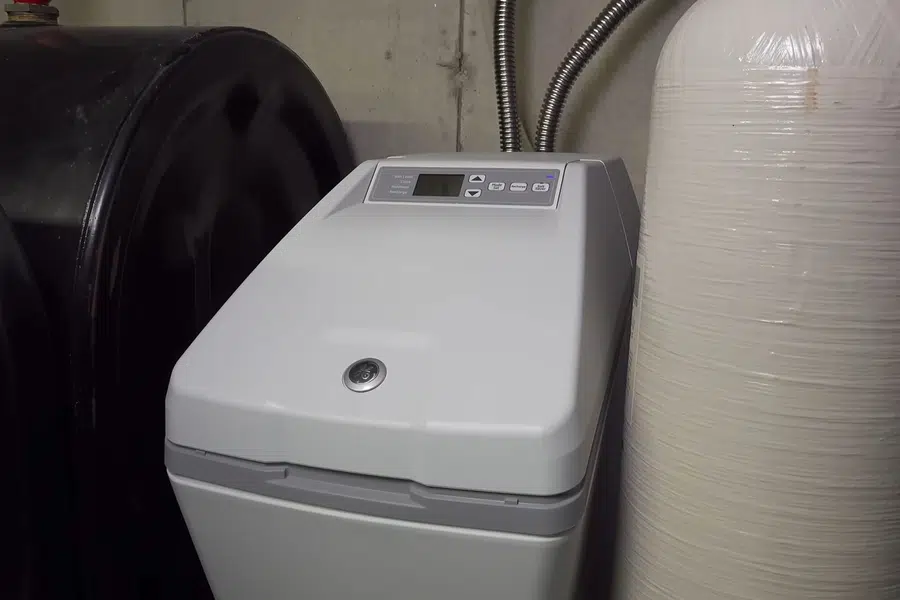
A water softener removes the calcium and magnesium that make water hard, usually by exchanging them for a small amount of sodium. With those minerals gone, the water stops leaving scale. That means no new buildup in your water heater, your pipes, your fixtures, or your appliances. We explain the hardness problem itself in our post on why Monrovia's water is so hard.
The everyday differences are noticeable: soap and detergent lather properly and you use less of them, dishes and glassware come out without spots, skin and hair feel less dried out, and fixtures stop crusting over. None of these is life-changing on its own, but together they are why people who switch rarely go back.
A quick honest aside: you may see salt-free water conditioners marketed as softeners. They are not the same thing. A true softener removes the hardness minerals through ion exchange, which is what actually stops scale. Salt-free conditioners alter how the minerals behave but do not remove them, and the results vary. In Monrovia's very hard water, a traditional salt-based softener is the proven choice when scale protection is the goal.
What a softener costs in Monrovia
Pricing depends on the system and your household, but here is a realistic picture for the area:
- A quality whole-house softener, installed, typically runs from about $1,500 to $3,500 depending on size and features
- Pairing it with filtration, which many homeowners do, pushes a combined system into roughly the $2,000 to $5,000 range
- Ongoing cost is mostly salt, usually a modest amount each month, plus occasional maintenance
- A well-maintained softener commonly lasts well over a decade
Those are honest mid-range numbers, not a teaser price. A softener is a real purchase, and we would rather you go in with a clear figure than a lowball that grows at install.
What a softener saves
The savings are real but spread out, which is why they are easy to underestimate. The biggest one is your water heater. In Monrovia's hard water, scale shortens heater life significantly, and a softener can add years before you face a replacement, which we cover in our water heater lifespan guide. For a tankless heater the case is even stronger, since hard water forces regular descaling, as we explain in our tankless and hard water post.
Beyond the heater, softened water means fixtures and cartridges that last longer and drip less, dishwashers and washing machines that run more efficiently and live longer, pipes that do not slowly scale shut, and less money spent on soap, detergent, and descaling products. No single line item is dramatic, but across a whole home over a decade, they add up to real money, often enough to offset much of the system's cost.
When a softener is worth it, and when it is not
A softener makes the most sense if you plan to stay in your home for years, if you have or are about to install a tankless water heater, if you have just repiped and want to protect the new system, or if hard water is visibly wearing out your fixtures and appliances. In those cases it is one of the better long-term plumbing investments you can make here.
It makes less sense if you are about to move, or if your main concern is drinking-water taste rather than scale, in which case a filtration system, possibly under-sink reverse osmosis, may be the smarter spend. Softening and filtration solve different problems, and an honest plumber will tell you which you actually need rather than selling you both by default.
The bottom line
In Monrovia's very hard water, a softener is one of the few upgrades that genuinely pays back over time, mostly by protecting your water heater and appliances from scale. Whether it is worth it for you comes down to how long you will stay, what you already have, and what is bothering you about the water. We are glad to look at your home and give you a straight answer, including when the honest answer is that you do not need one.
Frequently asked questions
How much does a water softener cost in Monrovia?
A quality whole-house softener, installed, typically runs from about $1,500 to $3,500 depending on size and features. Combined with filtration it can reach roughly $2,000 to $5,000. Ongoing cost is mostly salt plus occasional maintenance.
Will a softener really save me money?
Over time, yes, mainly by extending your water heater's life and protecting fixtures and appliances from scale. The savings are spread across many small line items, but in Monrovia's hard water they add up to real money over a decade.
Do I need a softener or a filter?
They solve different problems. A softener removes the hardness minerals that cause scale, while a filter improves taste and reduces chlorine and contaminants. Many homes benefit from both, but if your only concern is drinking-water taste, filtration alone may be enough.